From Curation To Refinement: Mapping the Word of the Year

Looking back, I can see the physical trail each word left behind—not just a label, but a job that required my hands.

Each one marked a kind of work season. Not abstract self-improvement, but real, physical, and emotional labor that left evidence behind.

The Foundation: Curate (2023–2024)

It started with the idea of my home as the museum of my life. These years were spent selecting and organizing—physically clearing out the accumulation of things that no longer spoke to who I am.

Curate was heavy lifting. It required decisions: what deserved to stay in the collection, and what was simply taking up space. Letting go wasn’t always easy, but it was necessary. Space had to be made before anything else could happen.

The Fuel: Nourish (2025)

Once the space was cleared, it needed to be filled with the right things.

Nourish became about the tactile work of tending—to body, mind, and spirit. This was the year of actual, countable words on the page. The year of sweating through physical health, rebuilding stamina, and allowing quiet back into my days.

Nourishment wasn’t indulgent. It was foundational. You can’t refine what hasn’t been fed.
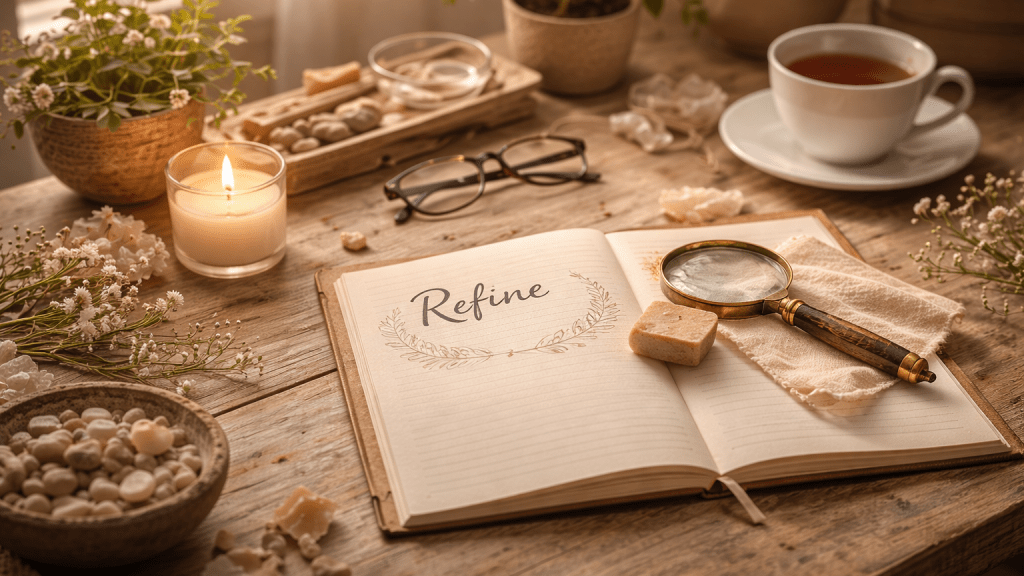
An open notebook on a rustic wooden desk showing the word 'Refine' in elegant script, surrounded by a lit candle, a cup of tea, a magnifying glass, and a fountain pen.
“Moving past the gathering phase and into the deliberate work of the polish.”

The Polish: Refine (2026)

Now I’m stepping into the year of Refine.

If Curate was about gathering the right materials, and Nourish was about helping them grow, Refinement is the friction of the grain against the wood; it’s the fine dust that settles on the desk after a long day of sanding down a rough draft.

This year, I’m looking closely at my habits, my writing, and my daily rhythms and asking: How do I make this sharper? What needs to be smoothed? What obstacles need to be removed—not dramatically, but deliberately?

Refine isn’t about doing more. It’s about doing better with what’s already here.

The Future: Sustain & Flourish (2027–2028)

Growth isn’t a sprint; it’s a long-term project.

2027: Sustain.
This will be the year of the steady rhythm. It’s the work of oiling the tools so they don’t rust and checking the fence lines before the storm hits. I’ll be building the systems—the daily habits—that keep the work standing on its own, so I’m no longer reinventing the wheel every morning.

2028: Flourish.
This is the projected destination. After years of clearing, nourishing, and refining, I want to stop endlessly preparing and start seeing results—income, sustainability, and the quiet satisfaction of work that finally pays back some of what it has taken.

Not unchecked growth. Not burnout disguised as success.
Flourish is the heavy weight of a harvest basket—the literal fruit of four years of curating, nourishing, and refining.
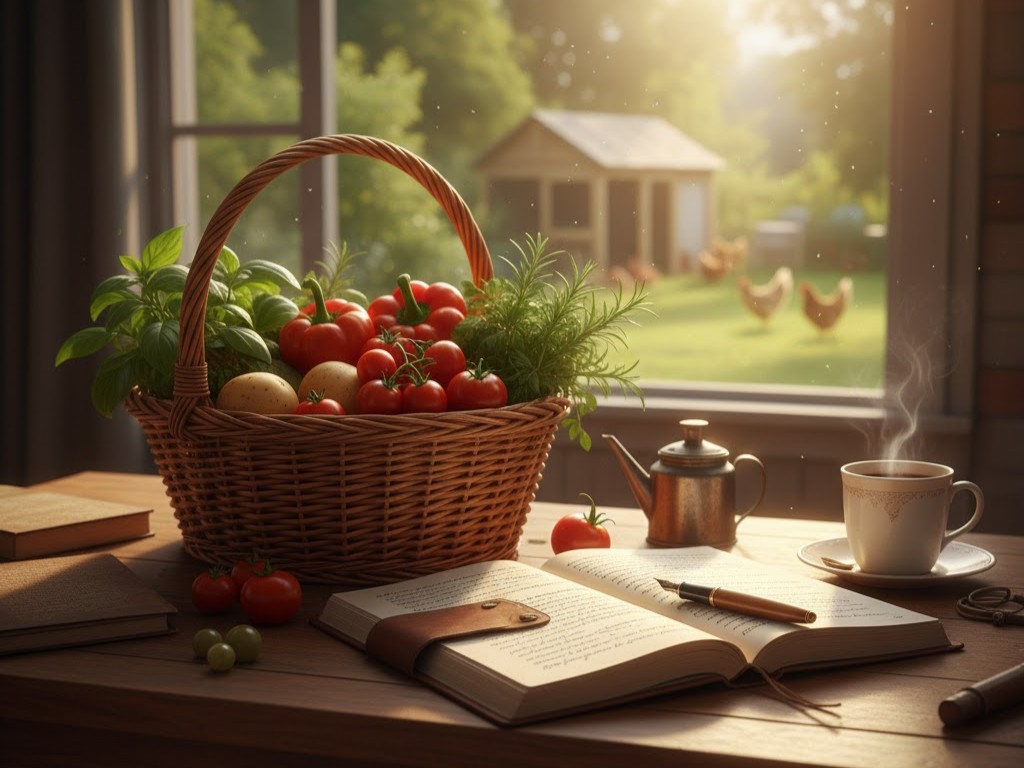
“A season of flourishing, earned one day of work at a time.”

So this year, I’m not asking myself who I want to become.

I’m asking what work is ready for my hands.

What is your work this year?
What word are you putting your hands to in 2026?

The Evolution of a Voice: 34 Years of Journals in a Tote

A tabby cat sleeping on a green knitted blanket draped over a grey Rubbermaid tote, with a bookshelf and warm window light in the background.

​The heavy grey Rubbermaid tote that sits in the corner of my living room is covered with a green blanket. It has been the cat’s bed for the last nine years. Last week, I moved the blanket, slid the lid off, and stepped into the library of my life.

​The tote is full of my old journals.

​I sifted through, pulling out black hardcovers, brown leather-bound books, black-and-white composition books, and a few spiral-bound notebooks as well. Some pages were yellowed with time and fragile; others were stark white, as if time-proofed in some way. When I got to the bottom, I found the steno notebook with “#1” written in blue ballpoint pen on its aged cover.

​The first entry is dated February 25th, 1991.

Looking through them, I realized I was uncovering the archive of my own evolution. I can see the progress of my life by how the writing has changed. In the earlier years, the entries were a reflection of the walls around me. I wrote what I felt safe writing. If my environment wasn’t secure, the details were sparse and guarded. I used vague language and leaned on hints rather than facts, dancing around the truths of what I was experiencing.

​But as the years moved forward, the pages started to fill up, and the shadows disappeared. The more I grew and secured my own life, the more detail I put down. I stopped using code. I began to name the people, the places, and the raw truths of my experiences. The shift was gradual from those thin, careful notes in that first steno book to the unfiltered, sprawling entries of the later years, where nothing is hidden.

The physical journals in the tote stop on October 22, 2025. The writing didn’t end there, but the medium did. On October 23, 2025, I began recording my life in the digital space for the convenience of it. While the decades of paper remain in that tote, my new entries allow me to organize my life in a way I couldn’t before. Moving forward, I can search my thoughts with a few keystrokes, making it easy to track recurring themes and patterns as they happen.

Looking at that stack—from the blue ink of the ’91 steno book and thinking of the digital entries I’m making today—I’ve done a lot of work. Now, as I start to build a searchable history, I’m curious to see where I go from here.

​It feels like success.

Memories of Letter Writing: From Crayons to Classrooms

When do we count the start of our experience?
I remember when I was 4, maybe 5, lying on the yellow shag rug in my bedroom, writing my first letter. I wrote that letter to the mailman in crayon, on the back of a junk mail envelope. I wrote the second letter as a follow-up to the first one, which hadn’t received a response. I wrote three letters that winter, trying to get a response. I did not succeed.

A young child with blonde hair lies on their stomach on a thick, yellow shag rug, focused on writing or drawing with a crayon on a piece of paper. The room is filled with soft, warm light, and a colorful, checkered bedspread is visible in the background.


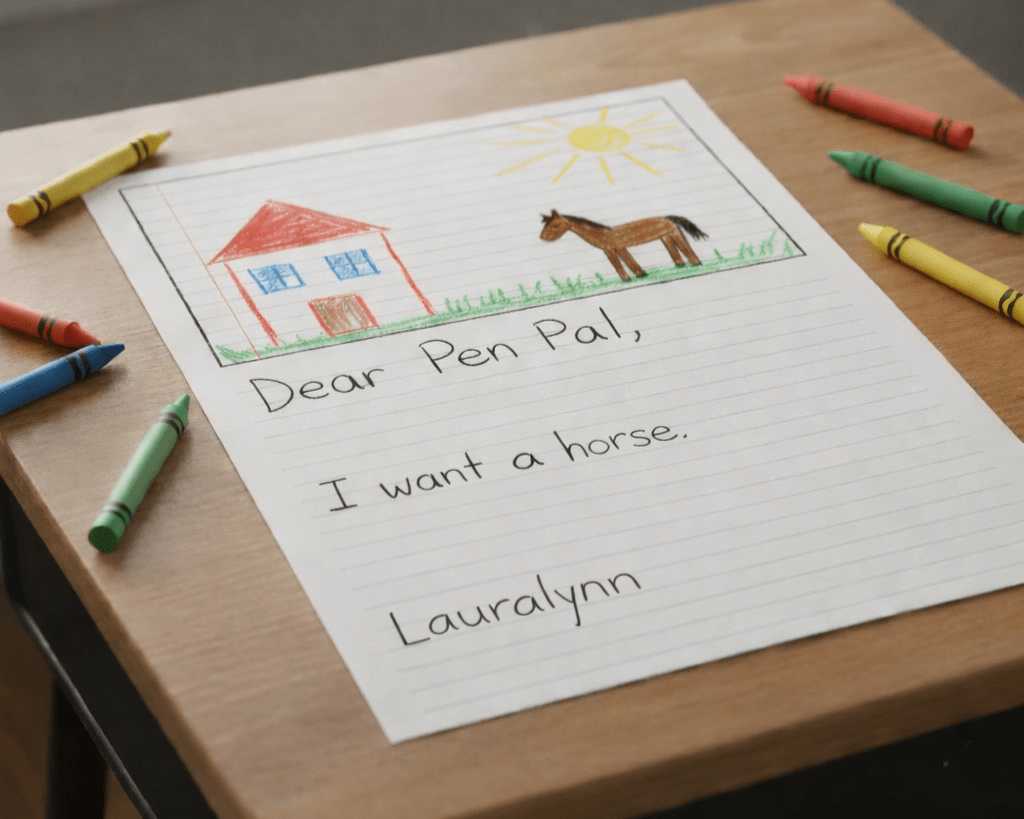
The next memory I have of letter writing is the assigned pen pals in second grade. The teacher gave each student a sheet of penmanship paper with a space at the top for a drawing. The assignment was to draw a picture of something we wanted, and to write a letter about it. I drew a picture of a one-story house with green grass and a big yellow sun. The teacher proofread it and told me I had misspelled ‘horse’ as ‘house’. She pointed to the lawn in the lower corner of the picture and told me to draw a horse there. I did as I was told.

A child's letter on lined penmanship paper lies on a wooden desk surrounded by scattered crayons. The letter, signed "Lauralynn," says "Dear Pen Pal, I want a horse." Above the text is a drawing of a red house with a brown horse standing on the grass next to it under a bright yellow sun.


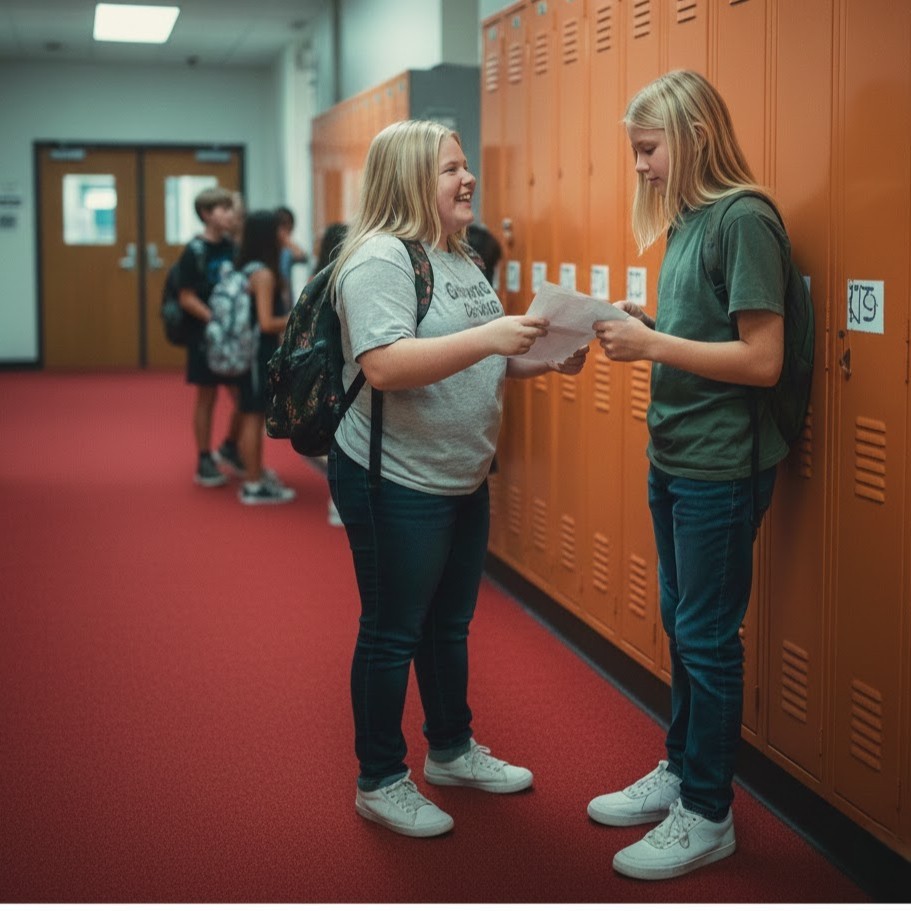
In middle school, passing notes became a big deal. I remember the orange lockers that lined the red carpeted main hall of our Jr. High School. I met my round-faced friend at the library steps after lunch. I handed her a letter. “I’m thinking of being a writer,” I said to her.
She glanced at the paper before she shoved it back at me.
“You didn’t read it,” I said.
“I don’t need to,” she laughed, “you can write a three-page letter about hair spray, and make it interesting.” She turned to the right and headed to class.

Two middle school students stand in a hallway with red carpeting and a row of bright orange lockers. One student, wearing a grey t-shirt and backpack, holds a handwritten letter while talking to a friend in a green shirt. Other students are blurred in the background, creating a busy school atmosphere.


I went on to write for classes in high school and college, with a few miscellaneous pen pals here and there. I’ve written a few speeches, as well as some marriage ceremonies and church services. In addition to my blog and social media posts, I currently write a class outline and student handouts for a local photography group.

A wooden desk holds a laptop displaying a "Photography Class Outline" and several printed "Photography Class Handouts." An open journal with handwritten notes sits in the foreground with a pair of reading glasses nearby. A camera, a white coffee mug, and a smartphone are also on the desk, illuminated by soft window light.

Tangled Words: A Writer’s Resistance

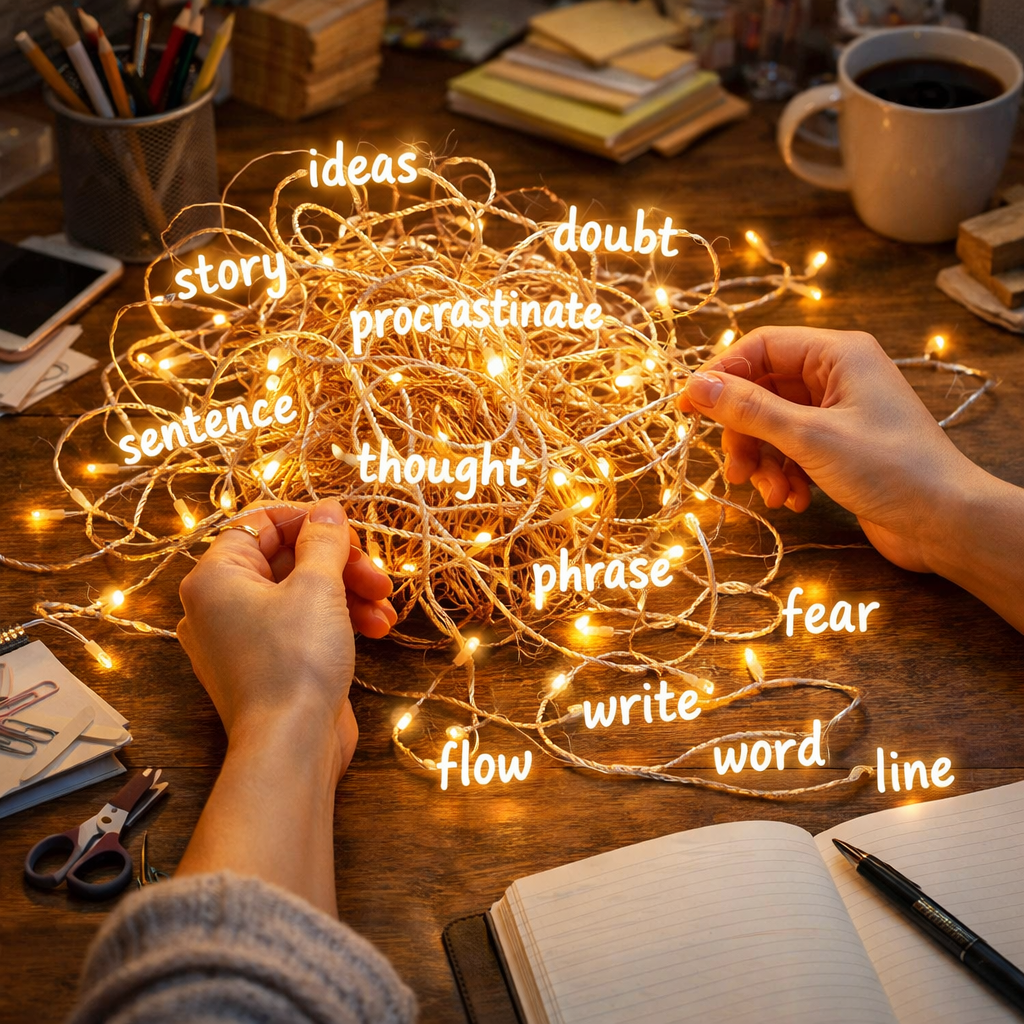
A person's arm rests on a wooden desk next to an open, blank notebook and a black pen. Strings of warm, glowing fairy lights are tangled around the writer's hand and spread across the desk. Floating white text among the lights displays words like "fear," "write," "flow," "word," and "line," illustrating the mental struggle of untangling ideas.

I don’t get writer’s block. I get writer’s resistance—a persistent, internal pushback against the act of writing, even though the words are there. While writer’s block feels like a void where ideas should be, resistance is more like a tangled knot of ideas that I hesitate to untangle. Every word I need is swirling around in my head. Each word collides with and ricochets off the letters of other words, forming a chaotic dance that makes it hard to separate them into coherent thoughts. It seems like a chore to sort the words from the others, like untangling a bundle of string lights where every strand is knotted with another. I often find myself doing anything else besides writing—organizing my desk, scrolling through social media, or even tackling chores I’d typically avoid, like cleaning out the junk drawer. But once I finally write, the words find their way to the page, one after the other. I wonder if I’ll ever learn to trust the words, to believe that once I untangle the knots and separate the strands, they’ll flow freely and weave themselves into something meaningful.

A person's arm rests on a wooden desk next to an open, blank notebook and a black pen. Strings of warm, glowing fairy lights are tangled around the writer's hand and spread across the desk. Floating white text among the lights displays words like "fear," "write," "flow," "word," and "line," illustrating the mental struggle of untangling ideas.