Memories of Letter Writing: From Crayons to Classrooms

When do we count the start of our experience?
I remember when I was 4, maybe 5, lying on the yellow shag rug in my bedroom, writing my first letter. I wrote that letter to the mailman in crayon, on the back of a junk mail envelope. I wrote the second letter as a follow-up to the first one, which hadn’t received a response. I wrote three letters that winter, trying to get a response. I did not succeed.

A young child with blonde hair lies on their stomach on a thick, yellow shag rug, focused on writing or drawing with a crayon on a piece of paper. The room is filled with soft, warm light, and a colorful, checkered bedspread is visible in the background.


The next memory I have of letter writing is the assigned pen pals in second grade. The teacher gave each student a sheet of penmanship paper with a space at the top for a drawing. The assignment was to draw a picture of something we wanted, and to write a letter about it. I drew a picture of a one-story house with green grass and a big yellow sun. The teacher proofread it and told me I had misspelled ‘horse’ as ‘house’. She pointed to the lawn in the lower corner of the picture and told me to draw a horse there. I did as I was told.
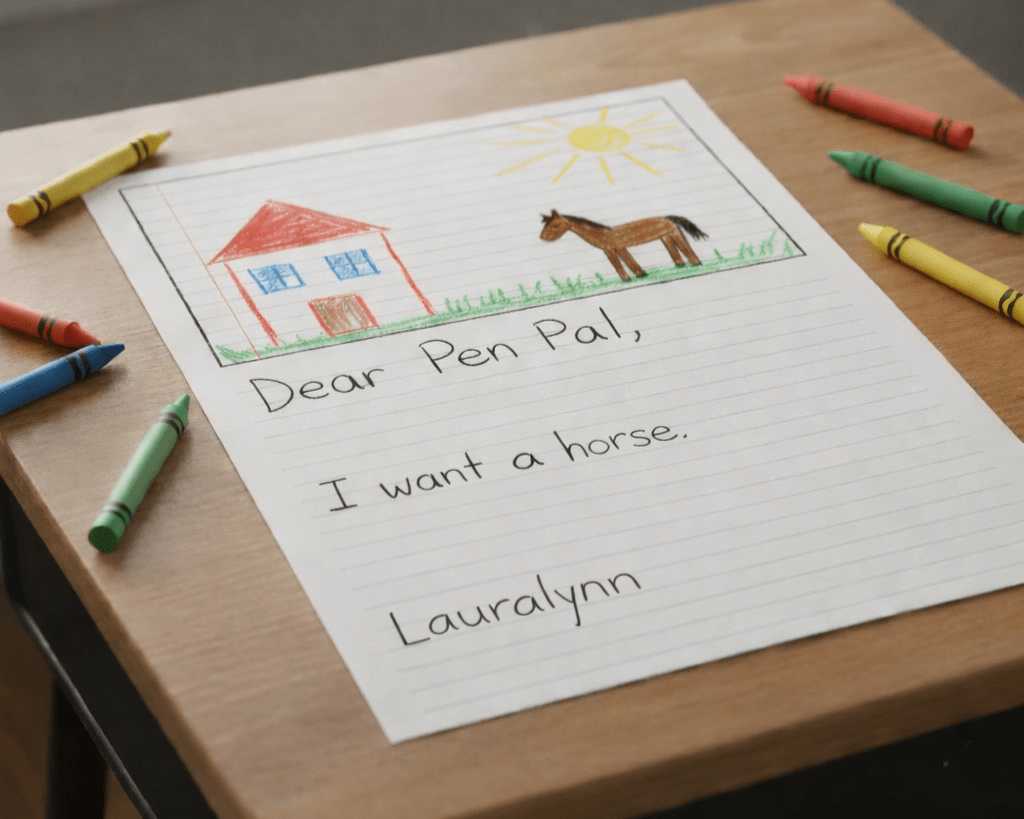
A child's letter on lined penmanship paper lies on a wooden desk surrounded by scattered crayons. The letter, signed "Lauralynn," says "Dear Pen Pal, I want a horse." Above the text is a drawing of a red house with a brown horse standing on the grass next to it under a bright yellow sun.


In middle school, passing notes became a big deal. I remember the orange lockers that lined the red carpeted main hall of our Jr. High School. I met my round-faced friend at the library steps after lunch. I handed her a letter. “I’m thinking of being a writer,” I said to her.
She glanced at the paper before she shoved it back at me.
“You didn’t read it,” I said.
“I don’t need to,” she laughed, “you can write a three-page letter about hair spray, and make it interesting.” She turned to the right and headed to class.
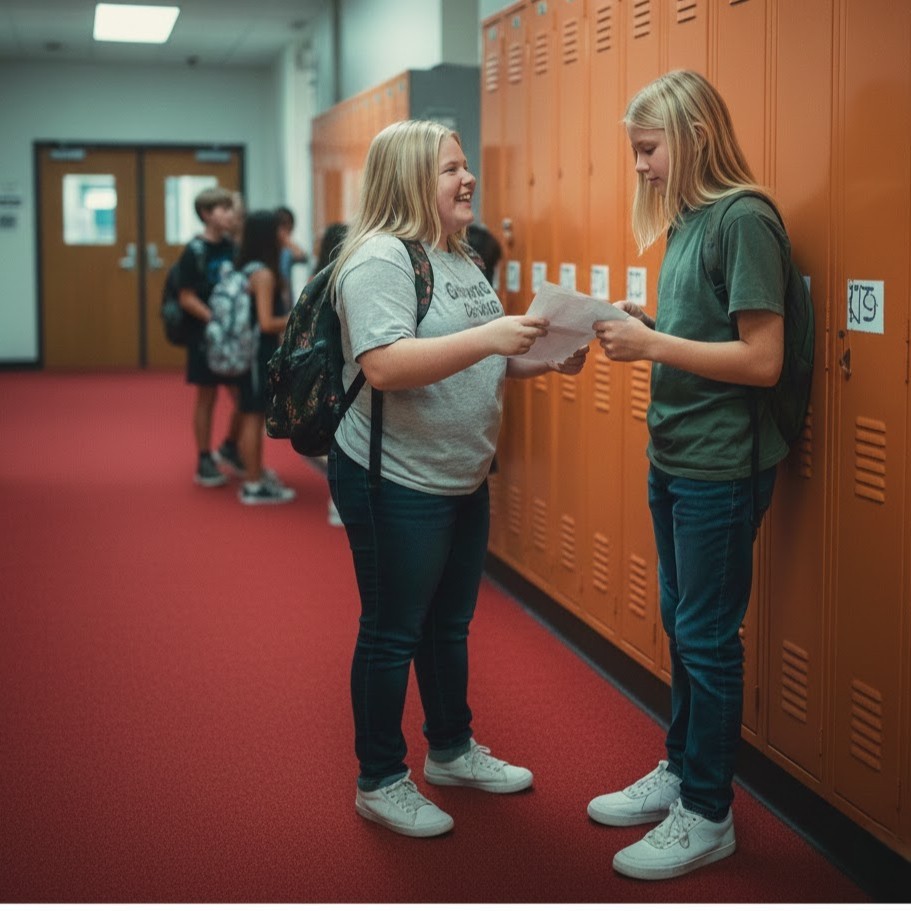
Two middle school students stand in a hallway with red carpeting and a row of bright orange lockers. One student, wearing a grey t-shirt and backpack, holds a handwritten letter while talking to a friend in a green shirt. Other students are blurred in the background, creating a busy school atmosphere.


I went on to write for classes in high school and college, with a few miscellaneous pen pals here and there. I’ve written a few speeches, as well as some marriage ceremonies and church services. In addition to my blog and social media posts, I currently write a class outline and student handouts for a local photography group.

A wooden desk holds a laptop displaying a "Photography Class Outline" and several printed "Photography Class Handouts." An open journal with handwritten notes sits in the foreground with a pair of reading glasses nearby. A camera, a white coffee mug, and a smartphone are also on the desk, illuminated by soft window light.

Exploring the Art of Rambling Letters

There is something quietly grounding about a letter.

Not an email dashed off between obligations. Not a notification blinking for attention. But a real letter—folded paper, deliberate words, a pause built into the act of reading.

Rambling Letters grew out of that longing.

For years, I’ve written my way through the seasons of daily life—on the mini homestead, at the kitchen table, during early mornings with coffee and a notebook. Some of those words felt like they wanted to travel farther than the page. Letters felt like the natural home for them.

Rambling Letters is my creative correspondence offering: a subscription-based letter sent through the mail, written slowly and intentionally, meant to be read the same way.

For those who still linger over letters.


What Is a Rambling Letter?

Each Rambling Letter is a personal piece of correspondence—one to two pages—written just as letters once were. The tone is thoughtful, reflective, and grounded in ordinary life.

A letter may include:

  • Observations from the homestead or garden
  • Reflections on the season or a passing moment
  • Thoughts on creativity, self-reliance, or everyday rituals
  • A story remembered, a question considered, or a quiet noticing

Some letters may be handwritten. Others may be typed on an old typewriter. Occasionally, a letter may include a small paper find—something useful for journaling, letter writing, or keeping tucked into a notebook.

No two letters are exactly alike. That’s part of the charm.


What Rambling Letters Are (and Are Not)

Rambling Letters are not newsletters.
They are not productivity tips or promotional flyers.
They are not meant to instruct or persuade.

They are simply letters—written to be received, read, and set aside for later if you wish.

If you enjoy:

  • Personal essays in letter form
  • Slow living and thoughtful correspondence
  • Words that feel human rather than polished

You’ll feel at home here.


Subscription Options

Rambling Letters are available through Etsy in several formats, so you can choose what suits you best:

  • A one-time letter
  • Monthly subscriptions (3 months, 6 months, or 1 year)
  • Quarterly letters aligned with the changing seasons

All subscriptions are mailed directly to you.

You can view current offerings and sign up here: A Field Note From a Writer’s Life
Or if you prefer my Etsy shop https://ramblingletters.etsy.com


An Invitation—Not an Obligation

Subscribing to Rambling Letters isn’t about keeping up. It’s about slowing down.

A letter arrives when it arrives. You read it when you’re ready. You keep it, pass it along, or tuck it into a drawer.

In a world that moves quickly and forgets easily, Rambling Letters is a small act of resistance—one envelope at a time.

If that speaks to you, I’d be glad to write to you.

Lauralynn

Tangled Words: A Writer’s Resistance

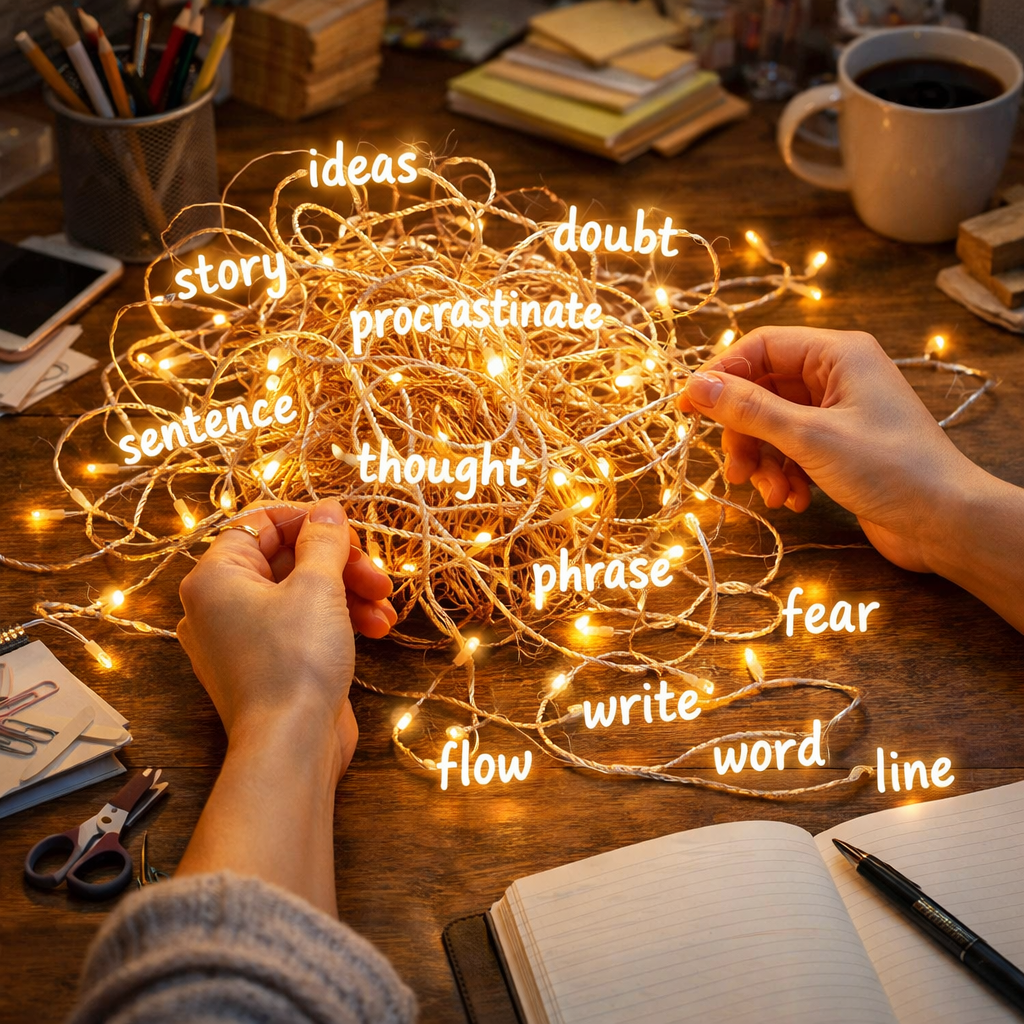
A person's arm rests on a wooden desk next to an open, blank notebook and a black pen. Strings of warm, glowing fairy lights are tangled around the writer's hand and spread across the desk. Floating white text among the lights displays words like "fear," "write," "flow," "word," and "line," illustrating the mental struggle of untangling ideas.

I don’t get writer’s block. I get writer’s resistance—a persistent, internal pushback against the act of writing, even though the words are there. While writer’s block feels like a void where ideas should be, resistance is more like a tangled knot of ideas that I hesitate to untangle. Every word I need is swirling around in my head. Each word collides with and ricochets off the letters of other words, forming a chaotic dance that makes it hard to separate them into coherent thoughts. It seems like a chore to sort the words from the others, like untangling a bundle of string lights where every strand is knotted with another. I often find myself doing anything else besides writing—organizing my desk, scrolling through social media, or even tackling chores I’d typically avoid, like cleaning out the junk drawer. But once I finally write, the words find their way to the page, one after the other. I wonder if I’ll ever learn to trust the words, to believe that once I untangle the knots and separate the strands, they’ll flow freely and weave themselves into something meaningful.

A person's arm rests on a wooden desk next to an open, blank notebook and a black pen. Strings of warm, glowing fairy lights are tangled around the writer's hand and spread across the desk. Floating white text among the lights displays words like "fear," "write," "flow," "word," and "line," illustrating the mental struggle of untangling ideas.